
Deep Excavation Monitoring in Singapore: Instruments, Responsibilities and Abnormal Trend Analysis
Deep excavation monitoring is not simply the collection of instrument readings. An effective monitoring system connects retaining-wall movement, groundwater behaviour, ground settlement, structural response and the construction sequence so that unusual trends can be identified, verified and interpreted before they become larger engineering problems.
One excavation. Several different behaviours to understand.
Deep excavation and ERSS works can influence the retaining wall, supporting system, groundwater regime, surrounding ground, adjacent structures and utilities at the same time. No single instrument gives the complete engineering picture. The value comes from correlating different monitoring systems with excavation depth, strut installation, dewatering, concreting and other critical construction activities.
Ground Response
Identify lateral soil movement, vertical settlement, possible ground loss and changes occurring within the excavation influence zone.
Water Response
Track groundwater levels and pore-water pressure behaviour that may influence deformation, seepage, basal stability and nearby settlement.
Structural Response
Observe retaining-wall deformation, strut or anchor load, building settlement, rotation, cracks and other indicators of structural response.
What each instrument is responsible for.
Instrument selection should respond to the anticipated failure mechanisms, ground conditions, ERSS arrangement, neighbouring assets and construction sequence. The following instruments are commonly considered for deep excavation monitoring in Singapore.
Inclinometer
Measures lateral deformation with depth in retaining walls or surrounding ground. Inclinometer profiles help identify the magnitude, direction and depth at which movement is developing, making them particularly useful for understanding wall deflection and possible localised ground movement.
Vibrating Wire Piezometer
Measures pore-water pressure at a defined elevation or soil layer. Piezometer trends can be compared with excavation and pumping activities to identify unexpected pressure reduction, pressure build-up or changes in hydraulic behaviour.
Water Standpipe
Provides groundwater-level information and is useful for understanding broader changes in the water table. Standpipes and piezometers should not automatically be treated as interchangeable because their hydraulic response and the parameter being observed can differ.
Ground Settlement Marker
Detects vertical ground movement around the excavation. Settlement markers are especially important where roads, pavements, utilities, buildings or other sensitive assets may be affected by ground movement.
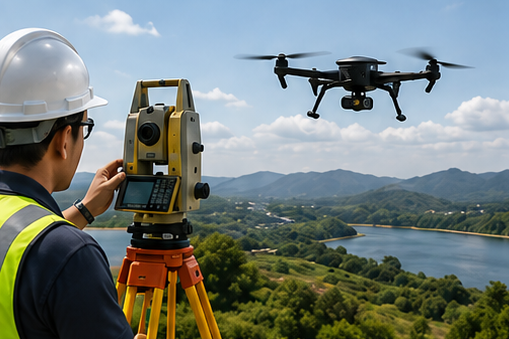
Survey Prism / Automatic Total Station
Tracks three-dimensional movement of retaining walls, buildings or other structures. Automated systems can provide higher-frequency data, while stable control points and independent verification remain essential for distinguishing real movement from survey-system effects.
Strut Load Cell / Strain Gauge
Monitors the axial response of steel struts or other support elements. Load trends should be interpreted together with excavation stages, preload records, structural configuration and temperature effects.
Tiltmeter
Detects rotation of buildings, retaining structures or selected structural elements. Tilt data becomes more meaningful when correlated with settlement, prism movement and visible structural observations.
Crack Meter
Measures changes in crack width across an existing or developing crack. The objective is not simply to record a crack, but to determine whether the crack is stable, progressively opening, closing or responding to nearby construction activities.
Vibration Monitor
Measures construction-induced vibration associated with activities such as piling, breaking or other dynamic works. Vibration data should be time-correlated with construction events and the applicable project-specific criteria.
Building & Utility Monitoring
Settlement points, prisms, tiltmeters, crack meters or other appropriate instruments can be installed on neighbouring buildings and utilities where movement within the excavation influence zone requires observation.
The important point: instruments should not be interpreted in isolation.
A 5 mm change in one sensor does not automatically explain the engineering mechanism. The direction, rate, location, construction stage, neighbouring instruments, baseline quality and independent observations all need to be considered before a conclusion is reached.
From a reading to an engineering decision.
A credible deep excavation monitoring programme requires more than a dashboard. Data should move through a controlled process that separates measurement, verification, interpretation and engineering response.
Common abnormal conditions — and what should be checked first.
An abnormal reading is not automatically an abnormal geotechnical condition. A useful monitoring team first asks whether the change is real, then asks what mechanism could explain it. The following examples illustrate common diagnostic thinking during deep excavation works.
Accelerating Inclinometer Movement
Unexpected Groundwater Drawdown
Sudden Settlement at One Point
Area-Wide Settlement Trend
Strut Load Rising Faster Than Expected
Several Prisms Jump at the Same Time
Building Tilt with Increasing Settlement
Single-Sensor Spike
Diagnosing movement during a staged urban excavation.
Scenario
Excavation progresses through several supported stages. After a deeper excavation stage, one inclinometer shows an increasing lateral movement trend. At approximately the same period, several nearby groundwater instruments indicate a change and a group of external settlement points begins to move gradually.
Initial observation
Looking at the inclinometer alone could suggest that the retaining wall is simply deforming more rapidly. Looking at the complete monitoring system produces a different question: is the wall response related to the excavation support sequence, groundwater change, ground loss, or a combination of effects?
Engineering verification
The appropriate response is to verify the suspect instruments, review the excavation and support sequence, compare neighbouring monitoring arrays, review pumping and groundwater information, inspect the excavation and assess whether observed movement is spatially and mechanically consistent.
Key lesson
Monitoring data is strongest when independent instruments tell a consistent engineering story. When instruments disagree, the disagreement itself is valuable information and should trigger investigation rather than an immediate assumption about the cause.
Look for relationships, not isolated numbers.
Wall Movement + Strut Load
Correlation can help assess whether changes in retaining-wall behaviour are accompanied by a corresponding response in the support system.
Groundwater + Settlement
A groundwater change occurring together with wider ground settlement deserves different investigation from an isolated settlement-marker jump.
Settlement + Building Tilt
Differential settlement combined with building rotation provides a more complete picture of adjacent-structure response than either measurement alone.
Prisms + Manual Survey
Independent survey verification is useful when an automated system shows an unexpected shift or when reference stability is uncertain.
Vibration + Construction Log
Time correlation with piling, breaking or other activities helps separate construction-generated events from unrelated signals.
Monitoring + Construction Sequence
Excavation depth, strut installation, dewatering and other critical activities provide the engineering context required to interpret monitoring trends properly.
Not every abnormal reading means the ground moved.
Deep excavation monitoring systems operate in active construction environments. Instrument damage, unstable survey control, disturbed settlement markers, temperature effects, cable faults, communication interruptions and incorrect baselines can all create misleading readings. A reliable monitoring process therefore combines automated screening with engineering verification.
Verification does not mean ignoring an alarm.
It means rapidly establishing whether the signal is repeatable, whether independent instruments confirm it, whether the timing matches the construction sequence and whether site observations support the same interpretation. Where an approved project review level is reached, the applicable project notification and response procedure should be followed.
Monitoring strategy must be project-specific.
Singapore deep excavation projects may be governed by different regulatory, authority, client and contract requirements depending on the nature and location of the works. Monitoring instrument types, locations, frequencies, accuracy, review levels, reporting requirements and response procedures should therefore follow the approved design, project specifications and requirements of the relevant Qualified Person, Professional Engineer and authority where applicable.
Explore related instrumentation and monitoring services.
Deep excavation monitoring FAQ.
What instruments are commonly used for deep excavation monitoring in Singapore?
Depending on the ground conditions, excavation system and surrounding assets, a monitoring programme may include inclinometers, vibrating wire piezometers, water standpipes, settlement markers, survey prisms, automatic total stations, strut load cells or strain gauges, tiltmeters, crack meters and vibration monitors.
What is the main purpose of an inclinometer in deep excavation monitoring?
An inclinometer measures lateral deformation with depth. For an ERSS excavation it can help identify retaining-wall or surrounding-ground movement and show where deformation is concentrated vertically.
Why are piezometers important in deep excavation works?
Piezometers measure pore-water pressure at selected elevations. Monitoring pressure behaviour helps engineers understand how excavation, dewatering and groundwater-control activities may be influencing the geotechnical system.
Does an abnormal monitoring reading always indicate dangerous movement?
No. An abnormal value can result from real ground or structural movement, but it can also result from instrument disturbance, survey-control movement, communication errors, temperature effects or other measurement issues. The reading should be verified and correlated with independent information before its cause is concluded.
How should monitoring alert levels be selected?
Review, alert, action and work-suspension levels should be established specifically for the project based on the approved design, predicted behaviour, relevant authority requirements and the requirements of the project’s Qualified Person or Professional Engineer where applicable.
What makes a good deep excavation monitoring report?
A useful report goes beyond listing readings. It clearly presents baseline information, current values, trends, construction activities, instrument condition, review-level status, unusual changes and the engineering interpretation required to understand the behaviour of the excavation and surrounding assets.
Planning a deep excavation monitoring programme?
GEOUE supports instrumentation and monitoring for excavation, infrastructure and construction projects in Singapore, including monitoring planning, instrumentation deployment, data management, technical review and engineering interpretation through appropriate project delivery arrangements.
Discuss Your Project →Our Engineering Services
End-to-end instrumentation and monitoring solutions for safe, efficient and data-driven projects.

Instrumentation & Monitoring
Design. supply and installation of geo / structural instruments.

Soil Investigation
In-situ and lab testing
to assess ground conditions.

Geophysical Survey
Advanced geophysical methods
for underground mapping.

Geotechnical Consultancy
Technical advisory and design support for geotechnical works.

Survey
Precision surveying using total stations, GNSS, LiDAR and drones.
Structural Monitoring
Real-time monitoring of structures for performance and safety assurance.
Installation
Professional installation by experienced teams with strict quality control.

Maintenance
Routine maintenance, and data validation for long-term performance.
Singapore Project Experience
The GEOUE team members have participated in a wide range of geotechnical instrumentation and monitoring projects across Singapore, including transportation infrastructure, deep excavation, underground construction and private developments.

MRT & Rail Projects
Instrumentation and monitoring works for MRT lines and rail infrastructure.

Deep Excavation
Monitoring of deep basements and retaining structures in dense urban areas.

Building & Development
Monitoring solutions for high-rise, mixed-use and residential developments.
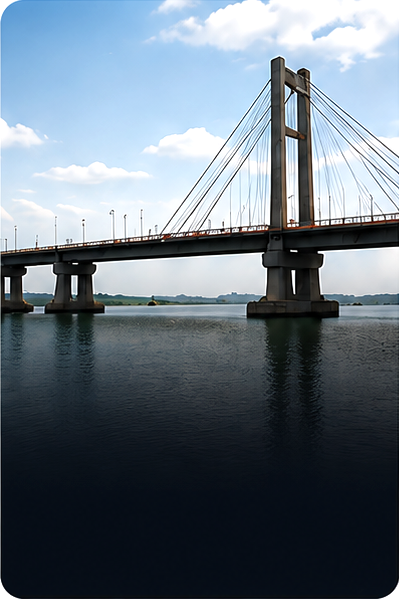
Bridges & Structures
Structural health and performance monitoring for bridges and infrastructure.
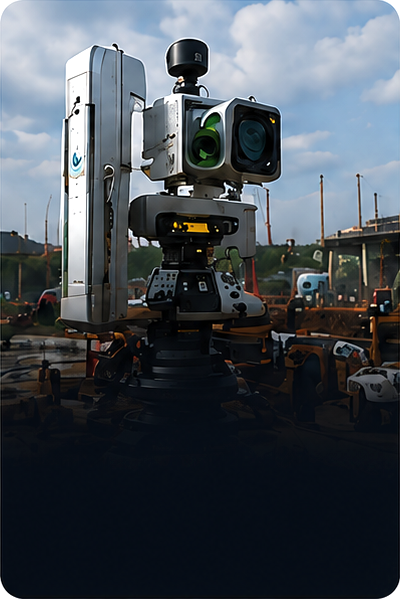
Industrial & Utilities
Instrumentation and Monitoring for utilities, tunnels, pipelines and industrial facilities.
Our Approach

Understand
We study your site and project requirements.

Monitor
We monitor, analyze and
provide actionable insights.

Design
We design the right
solution for your needs.

Partner
We partner with you to
ensure long-term success.

Deliver
We install and commission
with precision.

Support
We maintain and support
for the long term.
Our Core Services
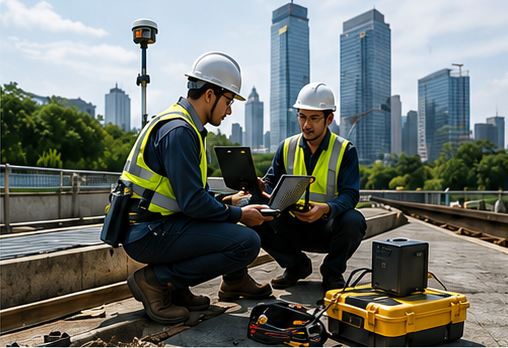
Instrumentation & Monitoring
Real-time data acquisition and monitoring for geotechnical and structural applications.
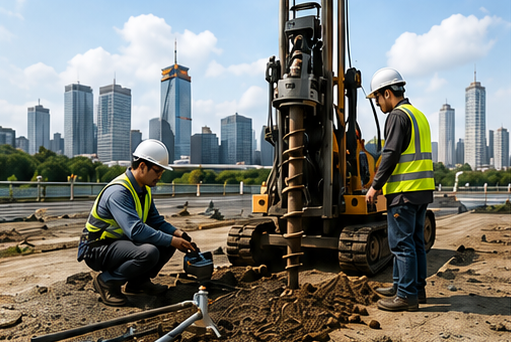
Soil Investigation
In-situ tests, sampling and laboratory analysis to evaluate subsurface conditions.
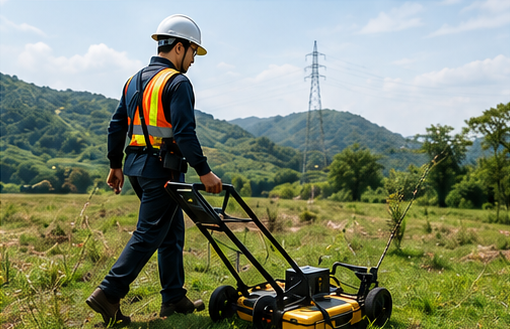
Geophysical Survey
Advanced geophysical methods to map subsurface conditions non-destructively.
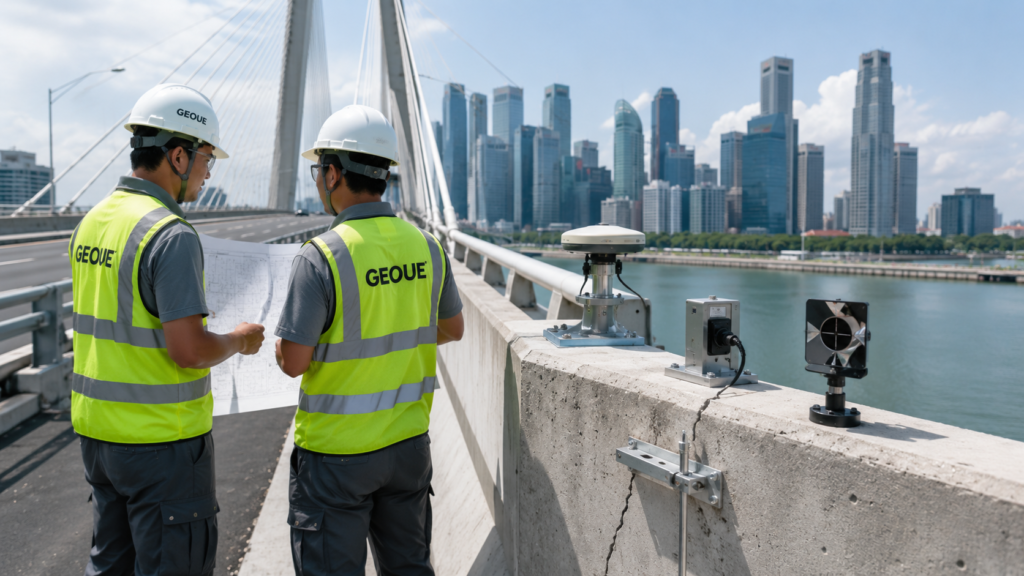
Geotechnical Consultancy
Design optimization and risk-based advice for safe and cost-effective solutions.

Monitoring Data Analysis
Trend Review
Alert Assessment
Interpretation
Technical Review
Third-party Review
QA/QC
Independent Assessment
Get In Touch
Let’s Work Together on Your Next Project
We deliver engineering solutions that make a difference.